Tag: archived

  • General Meeting papers

    Content to be added.

  • Committee and Officers

    St Pancras Cruising Club – Committee

    rnrn

    rn

    rn

    rn

    rn

    rn

    rn

    rn

    rn

    rn

    rn

    rn

    rn

    rn

    rn

    rn

    rn

    rn

    rn

    rn

    rn

    rn

    rn

    rn

    rn

    rn

    rn

    rn

    rn

    rn

    rn

    rn

    rn

    rn

    rn

    rn

    rn

    rn

    rn

    rn

    rn

    rn

    rn

    rn

    rn

    rn

    rn

    rn

    rn

    rn

    rn

    rn

    rn

    rn

    rn

    rn

    rn

    rn

    rn

    rn

    rn

    rn

    rn

    rn

    rn

    rn

    rn

    rn

    rn

    rn

    rn

    rn

    rn

    rn

    rn

    Name

    rn

    rn

    Position

    rn

    rn

    Email

    rn

    rn

    Colin Parlett

    rn

    rn

    Commodore

    rn

    rn

    commodore@stpancrascc.co.uk

    rn

    rn

    David Leppard

    rn

    rn

    Vice Commodore

    rn

    rn

    vicecommodore@stpancrascc.co.uk

    rn

    rn


    rn

    rn

    Rear Commodore

    rn

     
    rn

    Garrie Naden

    rn

    rn

    Hon. Treasurer

    rn

    rn

    treasurer@stpancrascc.co.uk

    rn

    rn

    Paul Willett

    rn

    rn

    Hon. Harbourmaster

    rn

    rn

    harbourmaster@stpancrascc.co.uk

    rn

    rn

    Tony Hay

    rn

    rn

    Hon. Secretary

    rn

    rn

    secretary@stpancrascc.co.uk

    rn

    rn

    Tim Lewis

    rn

    rn

    Committee member and Web Master

    rn

    rn

    rn

    Mikki Rain Committee member  
    Oli Soutar Committee member  
    rn

    Julie Clark

    rn

    rn

    Committee member

    rn

    rn

    Gardening Co-ordinator

    rn

    Sallyann Ford Committee member Membership officer   Membership@stpancrascc.co.uk
    rn

    Christina Oelgemoller

    rn

    rn

    Committee member

    rn

    rn

    Data Protection Officer

    rn

    Steve Burt Committee member  

    rnrn


    rnrn

    St Pancras Cruising Club – Other Officers

    rnrn

    rn

    rn

    rn

    rn

    rn

    rn

    rn

    rn

    rn

    Sash Keir

    rn

    rn

    Hon. Vice President

    rn

    rn

    vicepresident@stpancrascc.co.uk

    rn

    rnrn


    rnrn

    rnFull List Of Club Officers And Committee members 

    rn

  • An exploration of BARKING CREEK

    rn

    SPCC NOTES ON VISITING THAMES CREEKS

    rnrn

    An exploration of BARKING CREEK

    rnrn

    Barking Creek is still an active commercial navigation with small coasters trading from the wharfs in the lower reaches. Sadly traffic no longer uses the formerly navigable River Roding Navigation to Ilford Bridge, but with the advent of the new Barking Barrage it is again accessible by smaller craft and canoes. Headroom restrictions at the bridges stop its access by higher air draft craft. Prior booking of BOW LOCKS and BARKING BARRIER is essential.

    rnrn

    THE TIME TABLING OF THE TRIP IS CRITICAL. THE KEY ELEMENTS ARE SET OUT BELOW

    rn

    rnrn

    Exit Bow Locks HW, 3.5 hours Bow Creek Mouth HW, 3 hours

    rnrn

    rn

    Leave Barking Creek Mouth HW(LB), 0.8 hours Arrive Bow Creek Mouth HW, + 0.5 hours

    rn

    rnrn

    Barking Creek Mouth HW(LB), – 1.75 hours (NB: If you arrive later than + HW(LB), + 0.75 divert to Limehouse)

    rnrn

    Tour of Creek 0.9 hours maximum                              Arrive Bow Locks HW, + 1 hour (A diversion to Limehouse takes +2hrs)

    rnrn

    THE CRUISE DETAILS

    rnrn

    The trip involves pushing against the tide for much of the outward journey and some of the return trip. The timings depend on the engine size and the hull profile. The following times relate to a reasonable hull shape powered by a 1500cc engine.

    rnrn

    Two factors control the trip; the TIDES and WEATHER. A tide at the neap end is preferable to a Spring. The trip must be made in daylight with good visibility and a wind no greater than FORCE 3, preferably less.

    rnrn

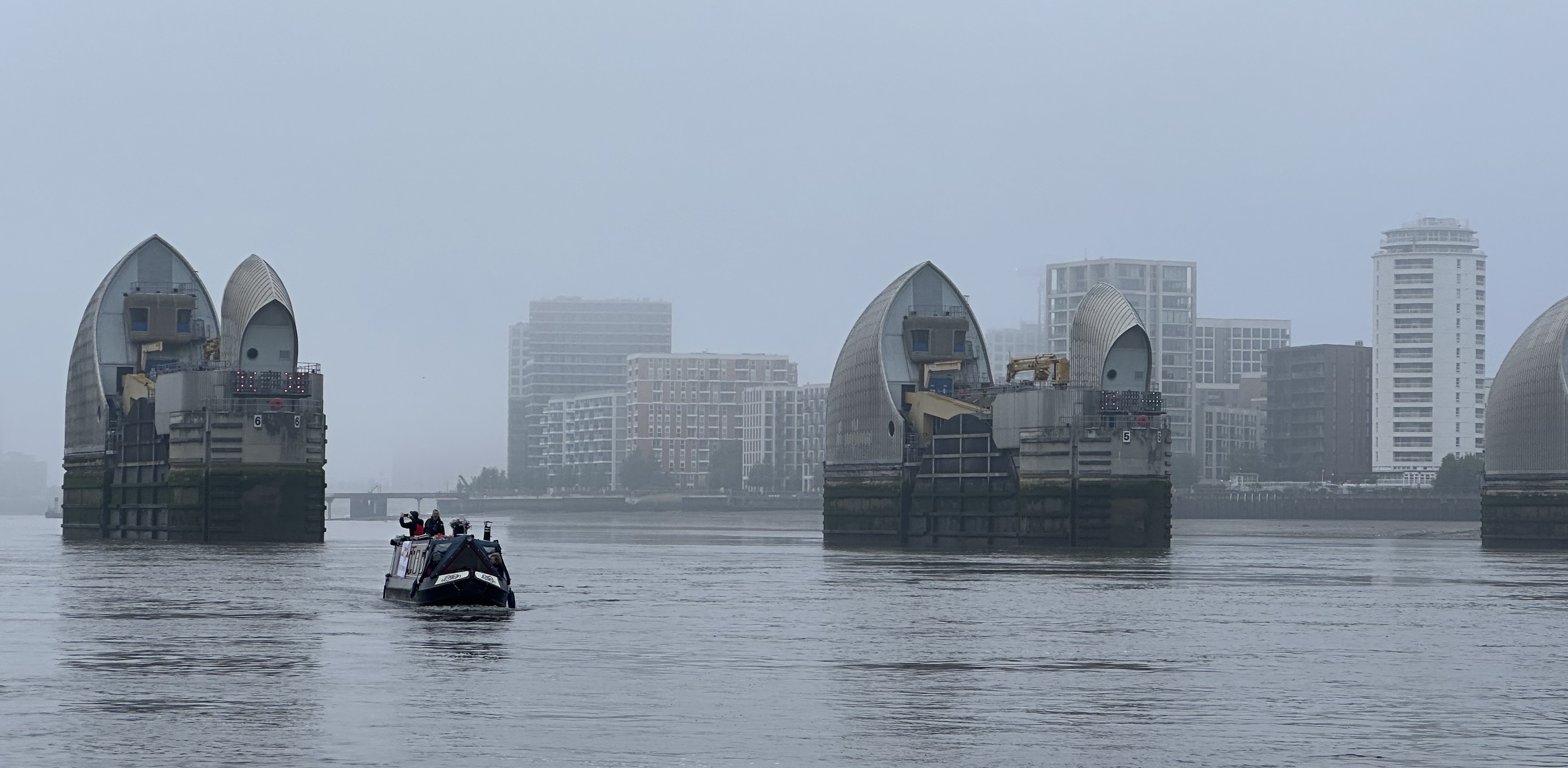
    The cruise starts at Bow Locks which must be pre-booked. Although the locks nominally open 4 hours before high water, experience suggests there is not usually enough water for a safe exit until around 3.5 hours before High Water. The lock keeper will tell us when the levels are right. Leave Bow as soon as the lock keeper allows and follow the centre line of the creek to the mouth. This will take about 30 minutes. Check for other craft on the Thames, then give a long blast on your horn and cross the fairway to follow the southern shore downstream. Call Woolwich Barrier Control (VHF 14) to gain clearance for transit. Pass between the green arrows at the Thames Barrier Spans. Check your passage past the Woolwich Ferry as they move very quickly from shore to shore. Continue downstream to the Barking Creek Mouth. Do not cross the fairway too soon as the tide run is on the Northern side here and it will push you upstream; i.e. turn below the Creek Mouth. Keep inside the Yellow Barrel Buoy which marks the end of a shoal and pass under the Flood Barrier at the Creek Mouth.

    rnrn

    The journey time from Bow Creek Mouth to Barking Creek Mouth is approximately 1 hour 20 minutes. Aim to arrive at the Creek Mouth around 1.75 hours before High Tide at Bow, but this is only 1.25 hours before High Water at Barking.

    rnrn

    Take extra care as you pass through the Barking Flood Barrier and proceed up the Creek following a centre line. Take extra care at the new Tidal Barrage site adjacent to Regent Oil Co. Wharf. Check that the lights are showing green which indicates the Barrage is open and proceed up to the Mill Pool where you turn. Watch out in the Creek for floating ropes, etc. The journey up the Creek to the barrage takes 20 minutes. The Mill Pool takes another 5 minutes.

    rnrn

    Take your photos but do not dawdle. Aim to spend 50 minutes maximum within Barking Creek before heading back upstream. The aim is to pass between the Green Arrows of the Thames Barrier before the tide turns. Here again clearance must be obtained for transit. (Call VHF 14).

    rnrn

    The aim is to reach Bow Creek Mouth by High Water Bow plus 20 minutes to ensure a safe transit back to Bow Locks which close 2 hours after High Water. You need to remember that by one hour after high water the tide run down the Creek gets much faster, and your progress against it much slower. In consequence if you enter Bow Creek Mouth later than one hour after high water you will have difficulty in reaching the locks before they close through lack of draught. In this situation it is better to continue up the Thames to Limehouse where the lock remains operational for 3.5 hours after HWLB. That journey, pushing against an out flowing tide will take at least 2 hours

    rnrn

    On arrival at the Locks at Bow the keeper should be waiting. You will then have completed your transit to Barking Creek. If you divert to Limehouse, please remember to phone Bow Locks to cancel your return booking. By prior arrangement, it is possible to stay over in Barking Creek above the barrier. In such circumstances the return trip can normally be made on the following day’s tide. It is best to leave as soon as the incoming tide makes a level and the barrier gates can open.

    rnrn

    USEFUL CONTACTS:

    rnrn

    Bow Locks Locks to the River Thames | Boating in London

    rnrn

    Barking Tidal Barrier 01474 562250,

    rnrn

    Weather Forecast 0891 226 456

    rnrn

    Woolwich Barrier Control 020 8855 0315,

    rnrn

    Barking Barrier Bookings 020 8227 3202,

    rnrn

    Barking Wharf Moorings 020 8591 7324

    rnrn

    ALL BOATERS AND SKIPPERS ARE REMINDED THAT THEY UNDERTAKE THE CRUISES COMPLETELY AT THEIR OWN RISK. THE ST. PANCRAS CRUISING CLUB AND ITS OFFICERS CANNOT ACCEPT ANY LIABILITY FOR THE SAFETY OF CRAFT ON RIVERS, CANALS OR THE TIDAL THAMES

    rn
  • Waterways of Eastern England

    Fossdyke & Witham Navigations Navigation authority: Canal & River Trust

    rnrn

    Facilities map (Fossdyke)

    rnrn

    River gauge data from Gaugemap Jim Shead’s waterway pages (Fossdyke)

    rnrn

    im Shead’s waterway pages (Witham) Simon Judge’s blog on the Witham Navigable Drains Boat Clubs:

    rnrn

    Burton Waters Boat Club Torksey Yacht Club

    rnrn

    Wash Transit

    rnrn

    Wisbech Harbour Authority

    rnrn

    Local Notices to Mariners

    rnrn

    Simon Judge’s blog of his Wash transit in 2015.

    rnrn

    River Great Ous

    rnrn

    e Navigation authority: Environment Agency (EA)

    rnrn

    Bridge heights,

    rnrn

    locks,

    rnrn

    overhead power lines and facilities

    rnrn

    River advice Navigation closures, notices and river conditions

    rnrn

    Register for the EA strong stream

    rnrn

    alerts for the Bedford Ouse (Earith to Bedford) EA waterways team Twitter feed River gauge data from Gaugemap Great Ouse Boating Association – well worth joining for access to their mooring sites. Facilities guide River levels Great Ouse Boater Facebook group Bridge Boatyard waterway map (download) Jim Shead’s waterway pages Boat clubs: Bedford Boat Club Denver Cruising Club Ouse Valley River Club Pike and Eel Boat Club (St.Ives) Upware Boat Club Whitehouse Boating Club (St Neots) Connected Waterways

    rnrn

    River Wissey River Little Ouse River Lark Cambridgeshire Lodes River Cam

    rnrn

    Navigation authority: Conservators of the River Cam

    rnrn

    Boating home page Short term licences River dimensions (download) Short stay moorings Facilities map River levels Cambridge City Council – moorings Jim Shead’s waterway pages Boat clubs: Cambridge Motor Boat Club (Waterbeach) Middle Level Navigations Navigation authority: Middle Level Commissioners Navigation Home Navigation Notes, River Advice for Boaters, Navigation Byelaws Navigation Map & Map showing minimum headrooms for low bridges Suspension of Navigation Notices Peterborough IWA – cruising times & distances Jim Shead’s waterway pages Bilfen Marina – map (download) Boat clubs: March Cruising Club Middle Level Watermens’ Club River Nene

    rnrn

    Navigation authority: Environment Agency

    rnrn

    Bridge heights,

    rnrn

    locks,

    rnrn

    overhead power lines and facilities River advice Navigation closures, notices and river conditions Guide to Visitor Moorings, Water Points, Pump-Out and Elsan facilities (download) Register for the EA strong stream alerts for the Nene EA waterways team Twitter feed River gauge data from Gaugemap Friends of the River Nene – maintain their own mooring sites Facilities guide Guide to Nene moorings Jim Shead’s waterway pages Peterborough IWA – cruising times & distances Boat clubs: Association of Nene River Clubs Barnwell Boat Club Elton Boat Club Middle Nene Cruising Club Northampton Boat Club Oundle Cruising Club Peterborough Yacht Club Other East Anglian Waterways Association

    rn

  • ​​​​​​​DARTFORD AND CRAYFORD NAVIGATIONS

    SPCC NOTES ON VISITING THAMES CREEKS

    rnrn

    DARTFORD AND CRAYFORD NAVIGATIONS

    rnrn

    The key to a successful visit to the Dartford and Crayford Navigations is the use of the tide. The Creek experiences high and low water approximately 45 minutes before London Bridge. (The Thames Barrier tide is 20 minutes prior to London Bridge). For simplicity this summary works on tide times at London Bridge. However, please remember the further downstream you are, the earlier the tide changes. One must always remember that progress against the tide run takes TWICE as long as passage with the tide. Also allow extra time for a boat with an engine under 35hp or with a less than smooth hull line. Because of this, the timings given in this sheet can only be a guide.

    rnrn

    The Dartford and Crayford Navigations effectively dry out at low tide. The Lock Gates at Dartford have been removed. The lock is now the head of navigation on that Arm It is still possible to visit, and turn in, the Terminus Basin on the Cray Arm, which lies just beyond the railway arch. This basin offers the only safe off-river mooring, if you miss the tide window or need to stay overnight, as it has a flat gravel bed.

    rnrn

    Dartford Creek Mouth lies 13 miles downstream of Limehouse Lock. With the out flowing ebb tide the journey takes around 2.5 hours, but even longer once the tide turns. The aim is to arrive at the Creek Mouth so that one can enter it 2 hours 15 minutes after low water London Bridge. It is only after this time, on the inflowing tide, that there is sufficient depth of water to make an easy entrance to the Creek mouth. This has to be entered from downstream because of a substantial silt bar that projects from the upstream end of the creek entrance.

    rnrn

    The safest way to visit the Navigations from the canal system is via Limehouse Lock and then to make full use of the ebb and flood tides. Boats should aim to exit Limehouse Lock 2 hours 15 minutes before Low Water London Bridge. This allows a passage downstream using the tail end of the ebb tide. Keep to the right hand third of the main river. To avoid a long wait for sufficient water in the Creek Mouth it is possible to continue downstream pushing against the tide to reach the Queen Elizabeth II Bridge. But remember you need to allow 20 minutes for the return to the Creek from the Bridge on the flood to arrive at the optimum entry time.

    rnrn

    If you decide to forgo the visit to the bridge, either turn downstream of the mouth and ‘bottom’ your craft on the mud in the entrance to the Creek; or better still, hold off against the barge buoys that are sited just downstream of the Creek Mouth at the south side of the main channel and wait for the flood to run in to provide sufficient water for entry into the Creek.

    rnrn

    By Low Water London Bridge plus 2 hours 15 minutes the water levels should be just sufficient to proceed slowly into the Creek and on through the Flood Barrage. Proceed slowly up the centre of the channel, monitoring water depth as you go. The Creek’s main arm is 2.25 miles in length, and this journey will take around 45 minutes. Turn in the wider area just below the lock, where an outlet on the west quayside scours out the mud. You can reverse from here into the lock chamber and take your photos—but do not wait too long. Allow 15 minutes to get back to the junction and a further half hour to explore the Crayford Arm. To do so, continue along the right hand arm and under the railway bridge, through to the Terminal Basin which is still navigable. By then the water depth will be good and should allow a speedy return to the Creek Mouth. High Water at Creek Mouth comes 45 minutes before HW London Bridge. Your aim must be to reach the main river well before that time so as to use the flow of the incoming tide to push you upstream. The round trip up the Creeks and back usually takes approximately 1 hour 35 minutes. You should aim to leave Creek Mouth for the return journey upstream by about High Water London Bridge minus 2 hours. This will provide you with a run on the incoming tide almost to the Thames Barrier.

    rnrn

    Be ready to step up your revs when the tide turns for the final leg to Limehouse Lock. As a rough guide you need to double your downstream times for that part of your return route after the tide has turned. You ETA should be around HW LB plus two hours, provided you have reached the Thames Barrier when the tide turns. This arrival is likely to be outside of Core Hours, thus the Limehouse Return Lockage will need to be pre-booked, at least two days in advance via the Canal & River Trust Web site at Locks to the River Thames | Boating in London. Lockmaster on VHF Channel 80.

    rnrn

    All transits through the Thames Barrier also need to be confirmed on the day of transit with London VTS (VHF Marine channel 14) or by phone 020 8855 0315. The first reporting call should be made when you are at Blackwall Point on the outward journey and again before the Woolwich Ferry on your return leg.

    rnrn

    All boats making the trip should ensure they have enough fuel. A full tank is preferable since sedimenting of filters caused by wave movement is then less likely to occur. Pushing against the tide doubles fuel consumption. Oil and water levels also should be topped up before you leave Limehouse. Your anchor must also be at the ready with 50 metres of line and at least 2 metres of chain at the anchor end.

    rnrn

    If the weather is forecast on the day is for winds above Force 3, or for poor visibility, you should postpone the trip to the next day. The timings then will be around one hour later. It is also wise to verify, in advance, with the Environment Agency that no Dartford Barrier test closure are planned to coincide with you intended date of transit.

    rnrn

    For ease of reference an indicative timetable would be:

    rnrn

    rn

    rn

    rn

    rn

    rn

    rn

    rn

    rn

    rn

    rn

    rn

    rn

    rn

    rn

    rn

    rn

    rn

    rn

    rn

    rn

    rn

    rn

    rn

    rn

    rn

    rn

    rn

    rn

    Low Water LB 11.15

    rn

    rn

    HW LB 17.03

    rn

    rn

    Out Limehouse Lock

    rn

    rn

    09.00

    rn

    rn

    Thames Barrier

    rn

    rn

    10.05

    rn

    rn

    Barking Creek

    rn

    rn

    10.30

    rn

    rn

    Crossness

    rn

    rn

    10.50

    rn

    rn

    Crayfordness

    rn

    rn

    12.00

    rn

    rnrn

    Moor or QEII Bridge and return

    rnrn

    rn

    rn

    rn

    rn

    rn

    rn

    rn

    rn

    rn

    rn

    rn

    rn

    rn

    rn

    rn

    rn

    rn

    rn

    rn

    rn

    rn

    rn

    rn

    rn

    rn

    rn

    rn

    rn

    rn

    rn

    rn

    rn

    rn

    rn

    rn

    rn

    rn

    rn

    rn

    rn

    Enter Creek

    rn

    rn

    13.30

    rn

    rn

    Dartford Lock (Turn)

    rn

    rn

    14.15

    rn

    rn

    Cray Junction

    rn

    rn

    14.25

    rn

    rn

    Crayford Basin (Turn)

    rn

    rn

    14.40

    rn

    rn

    Cray Junction

    rn

    rn

    14.55

    rn

    rn

    Out Creek Mouth

    rn

    rn

    15.10

    rn

    rn

    Barking Barrier

    rn

    rn

    16.30

    rn

    rn

    Thames Barrier

    rn

    rn

    17.10

    rn

    rn

    Limehouse Lock

    rn

    rn

    19.10

    rn

    rnrn


    rnrn

    ALL BOATERS AND SKIPPERS ARE REMINDED THAT THEY UNDERTAKE THE CRUISES COMPLETELY AT THEIR OWN RISK. THE ST. PANCRAS CRUISING CLUB AND ITS OFFICERS CANNOT ACCEPT ANY LIABILITY FOR THE SAFETY OF CRAFT ON RIVERS, CANALS OR THE TIDAL THAMES

    rn
  • THE TRANSIT TO THE MEDWAY

    SPCC NOTES ON VISITING THE RIVER MEDWAY

    rnrn
    THE TRANSIT TO THE MEDWAY

    rnrn
    THIS IS A CRUISE THAT REQUIRES PRE-PLANNING AND IS NOT FOR THE FAINT HEARTED

    rnrn

    Once you leave BOW LOCKS there are few places to land, and only barge buoys on which you can lay over. The last of these barge buoys are in the GRAVESEND REACH. Once you clear Lower Hope Reach you are very much ‘on your own’ until you are back in the Medway Channel. Good weather forecasts are essential for this section. If weather conditions change, there is a transit mooring pontoon at Gravesend, installed by the local Council in 2012. It will hold 12 narrowboats and can be booked via Chris Bentley at Gravesend Embankment Marina <chris@theembankmentmarina.net> Tel: 01474 535700.

    rnrn

    Navigation skills become critical when you reach the start of the THAMES buoyed channel at LOWER HOPE buoy, opposite MUCKING No.3 buoy. From here aim for the red WEST BLYTH buoy, which you can pass inside; that gets you around the end of Blyth Sands. From here look due East and steer for MID BLYTH, Yellow with Black Cap, North Cardinal buoy which is opposite Hole Haven Creek on the north bank. Take this buoy again on the inside, i.e. just outside of the main shipping channel. From here the next buoy lies ahead some three miles, east south east, and guards the edge of Yantlet Flats, (Binoculars are a must). Pass on the outside of this buoy and look ahead for the red can buoy of WEST NORE SAND which follows. Pass on the north side.

    rnrn

    Your route on the next section is quite critical as you need to avoid Nore Sand and follow the inner Swatchway channel past the length of Nore Sand. Thus, when leaving WEST NORE SAND buoy, identify and head for the green conical MID SWATCH buoy and pass to the south of it. This buoy is on the southern edge of Nore Sand. Look ahead and to the south east to identify the red can buoy of NORE SWATCH. Head for it and pass round to the north of this buoy and then, in a sweep, alter course to the south to pass over the Sheerness Middle Sand, which marks the end of Grain Spit, to head for MEDWAY BUOY No.11. Just before you reach it turn south south west, to pass between it and GRAIN EDGE buoy, which you will pass on the outside. From here head west south west to GRAIN HARD buoy; this is opposite Garrison Point. From here turn south south west to head for NORTH KENT buoy in Sheerness Harbour.

    rnrn

    You are now in the River Medway Channel. This tends to be busy with craft, but you will be passing through at low water when there is usually less big shipping on the move. Proceed parallel to the southern shore of the Isle of Grain. Turn at STOKE BUOY No.13 down Keyhole Reach past Bee Ness Jetty and Oakham Ness Jetty to BUOY No.15. Here head for BUOY No.17 and then turn due west, along Long Reach, turning south south west again at BUOY No.23, opposite Folly Point with its Napoleonic Fort, to proceed down Pinup reach to BUOY No.25 and thence to BUOY No.27 in GILLINGHAM REACH.

    rnrn

    For Skippers who need a break, the floating jetty of GILLINGHAM MARINA is over on the south side of the river. A call on VHF Channel 80 will reach Marina staff – Phone: 01634 280022.

    rnrn

    From here the trip up the Medway to the tide lock at Allington is quite straight forward. Remember that quite large craft use the river up to Rochester Bridge and that the final section of this reach before Strood Pier and the bridge, has two blind bends.

    rnrn

    From Rochester Bridge the river becomes more rural apart from the M2 bridge. Also remember that there are no more stopping places between here and ALLINGTON LOCK. Take care under the low Aylesford Bridge and your transit to the non-tidal section of the Medway is nearly at its end. From Allington the nine locks and 19 miles of the non-tidal section of the Medway will make your epic voyage well worthwhile. You may, however, need a long swing Medway windlass to get some of the heavy lock gear to budge, but that is a minor point.

    rnrn

    For the return journey, it may be easier to overnight at Gillingham Marina, or better still, rafted to Queenborough Yacht Club’s lighter in the Swale. Both provide a shorter hop to Grain Edge.

    rnrn

    SAFETY NOTE: THAMES ESTUARY WEATHER WARNING

    rnrn

    It is essential to verify that the WIND is not greater than Force 3, but preferably Force 1 or 2, before proceeding past SHORNMEAD LIGHT (TILBURY) on the way out, or past GRAIN HARD / GARRISON POINT on the return. You should turn back at these points if increases in WIND are forecast, as the journey through the ESTUARY takes 3 hours in an unprotected area with no shelter easily accessible

    rnrn


    rnrn

    TRANSIT TO THE MEDWAY

    rnrn

    This trip can only be undertaken when the weather forecast is Fine with Good Visibility and maximum Wind Force 3 in the Estuary. Transit starts from BOW LOCKS which need to be booked 24 hours in advance. (Phone 020 7517 5570) Avoid strong SPRING tides. The best CHART for the transit around GRAIN SPIT and the tidal Medway is Stanfords Chart No.8 The NORTH KENT COAST. Chart, compass and binoculars are essential for the lead boat. The remainder of the Thames route is on Imray Yachting Chart C2 River Thames (Teddington to Southend).

    rnrn

    BEFORE YOU LEAVE

    rnrn

    Check Weather Forecast before departure with Met Off ice (Phone 0891 226 455) and Medway Radio at Sheerness, Channel 74 (Phone 01795 663025). Speak to Port Control London to check the condition of and traffic on the lower tideway, Channel 13 (Phone 01474 560311). If forecast is not good DO NOT GO. (i.e. Wind in excess of Force 3).

    rnrn

    DEPARTURE ROUTINE

    rnrn

    Notify Thames Barrier/London VTS, Channel 14 (Phone 020 8855 0315) of your planned Barrier Transit when you clear Blackwall Point; and seek permission to transit when you have the barrier in sight

    rnrn

    TRANSIT MONITORING

    rnrn

    The timing of the transit is the key to success and you must keep a log of Way Points to verify your speed. In the Estuary and going up the Medway, mark off the buoys on your chart/checklist as you pass them. This way you will know exactly where you are. Remember to keep to the right hand third of the river and out of the Fairway channels used by larger craft.

    rnrn

    TRANSIT TIMINGS

    rnrn

    Timings of the transit are as follows:

    rnrn

    Leave BOW LOCKS                                                        HW LB –1 hour

    rnrn

    THAMES BARRIER                                                       AT HW LB

    rnrn

    FORD MOTOR WORKS DAGENHAM                                         HW LB +1 hour

    rnrn

    BROADNESS POINT/GRAYS                                                         HW LB +2 hours

    rnrn

    MUCKING No.3 BUOY/LOWER HOPE                                         HW LB +3 hours to +3.25 hours

    rnrn

    EAST BLYTH BUOY                                                       HW LB +4 hours to +4.25 hours

    rnrn

    NORE SWATCH BUOY                                                  HW LB +4.75 hours to +5.5 hours

    rnrn

    GRAIN EDGE BUOY or Medway Channel No.11                 HW LB +5 hours to +5.75 hours

    rnrn

    MED WAY TRANSIT

    rnrn

    Follow buoyed channel up Medway, keeping to RIGHT of Channel.

    rnrn

    GRAIN EDGE BUOY to ROCHESTER                              12 miles or approx. 2 hours

    rnrn

    ROCHESTER to ALLINGTON TIDE LOCK                       13 miles or approx. 2.25 hours

    rnrn

    (Allington Lock High Water is Sheerness +50 minutes)

    rnrn

    POINTS TO REMEMBER

    rnrn

    Timings of the Tideway can vary depending on tide flows. It is essential to be within the above Way Point timings for a safe passage. Non-tidal section of Medway—At ALLINGTON LOCK, which is open from THREE HOURS before to TWO HOURS after high water, buy your MEDWAY LICENCE for the non-tidal River. Chart The Upper Reaches of the River Medway. (Imray, Laurie Norie and Wilson). ALWAYS ENSURE THAT YOU GIVE LOCK KEEPERS ADVANCE WARNING OF YOUR E.T.A.

    rnrn

    MED WAY TIMINGS

    rnrn

    ALLINGTON to MAIDSTONE                                           0.5 hours

    rnrn

    MAIDSTONE to YALDING (8 miles 3 locks)                       2.5 hours

    rnrn

    YALDING to TONBRIDGE (8 miles 6 locks)                       3.75 hours

    rnrn

    Craft with air draught of less than 5.5 feet can proceed for about half a mile, turning just beyond the Tonbridge to London Railway Bridge where the river widens to return to the moorings at Tonbridge Town Wharf just below the main town road bridge.

    rnrn

    FOR THE RETURN JOURNEY USE THE SAME TIDEWAY TIMINGS IN REVERSE ORDER.

    rnrn

    Boats can break their Medway transit at Gillingham Marina, VHF 37/80 (Phone: 01634 280022). Allow 11/4 hours to Grain Edge or overnight rafted to the Queenborough Harbour Lighter. Contact Queenborough Yacht Club, 7 High Street, Queenborough, Sheppey, Kent ME11 5AA. Email secretary@queenboroughyc.co.uk for details. Allow 1/2 hour to Grain Edge.

    rnrn

    ALL BOATERS AND SKIPPERS ARE REMINDED THAT THEY UNDERTAKE THE CRUISES COMPLETELY AT THEIR OWN RISK. THE ST. PANCRAS CRUISING CLUB AND ITS OFFICERS CANNOT ACCEPT ANY LIABILITY FOR THE SAFETY OF CRAFT ON RIVERS, CANALS OR THE TIDAL THAMES

    rn